Write to the drawing table
Spirograph, 612 Grand Avenue, Suite 3, Beloit, WI 53511
contact@spirograph-4o0.pages.dev
contact@spirograph-4o0.pages.dev
Inspiring generations of artists for over 50 years!

How an engineer's drawing wheels became one of the best-known toys in the world, and what has changed in the box.
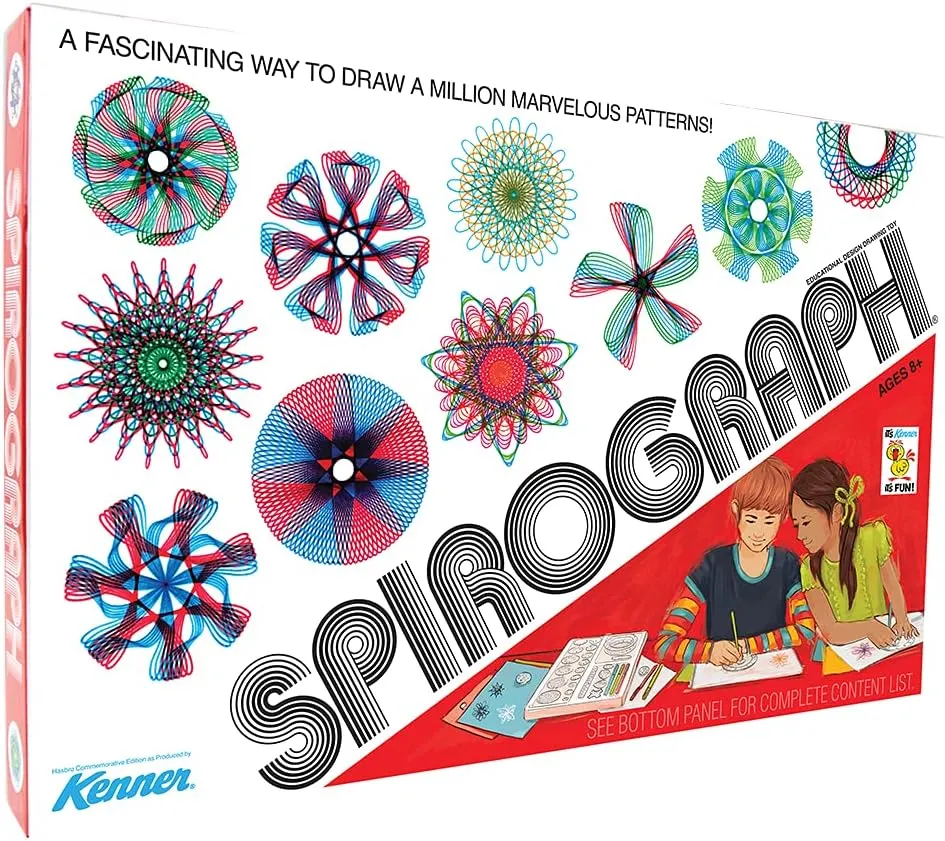
Spirograph began as an engineer's side project. Denys Fisher, a British engineer, spent the early 1960s refining a set of toothed plastic wheels and rings that could draw the looping curves mathematicians call hypotrochoids and epitrochoids. In 1965 he showed the result to the toy trade, and the first sets went on sale that year.
The idea crossed the Atlantic quickly. Within a couple of years Spirograph was in American toy aisles, and by the end of the decade it was the sort of present that reliably turned up at birthdays. The early sets used pins to hold the ring to a cardboard backing sheet, and a red pen and a blue pen to draw with.
The wheels and rings in our current sets keep the shapes of the originals. What changed is how they behave. They are precision engineered to take most standard pens, markers and pencils rather than only the ones in the box. Reusable putty replaced the pins, so paper stays whole and small fingers stay unpricked. Cases gained built-in work surfaces.
For the 50th anniversary we cast the wheels in metal for the first time, in the Die-Cast Collector's Set, and put a commemorative die-cast wheel into Super Spirograph. The Retro Deluxe reproduces the throwback packaging for anyone who wants the full memory.
Not everything since has been a revival. Spirograph Jr. brought the idea down to age three. Cyclex enclosed the wheels and made them advance on their own. More recently came Mandala Maker, Spirograph 3D, the first Giant Spirograph and an Electronic Spirograph Machine that draws at the push of a button. Each is a different answer to the same question: what else can a wheel inside a ring do?
Over fifty years on, the answer on the paper still looks the way it did in 1965, and the moment the line closes is still the best part.
Design guide 03 · updated October 2026
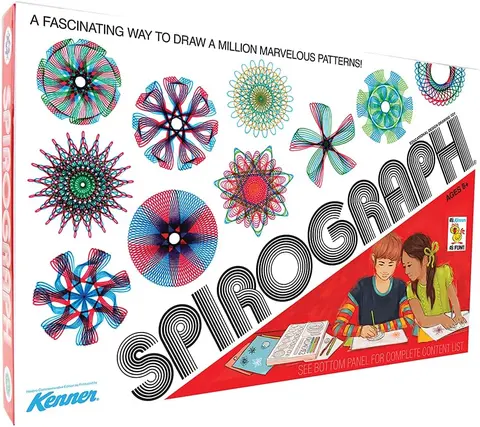
The Deluxe line-up in commemorative throwback packaging, just as you remember it.
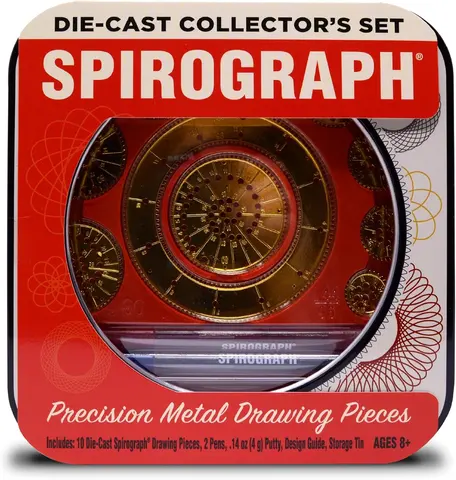
Nine golden die-cast metal wheels and a metal ring in a display tin.
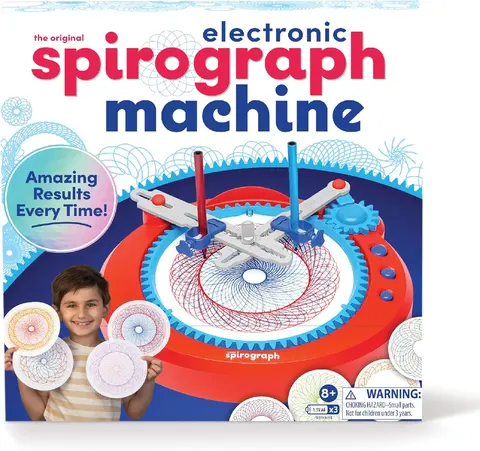
Set the arms, place the markers, press the button and watch it draw.