Write to the drawing table
Spirograph, 612 Grand Avenue, Suite 3, Beloit, WI 53511
contact@spirograph-4o0.pages.dev
contact@spirograph-4o0.pages.dev
Inspiring generations of artists for over 50 years!

Rings, wheels and the tooth-count trick behind every design, plus six habits that keep the wheel from slipping.
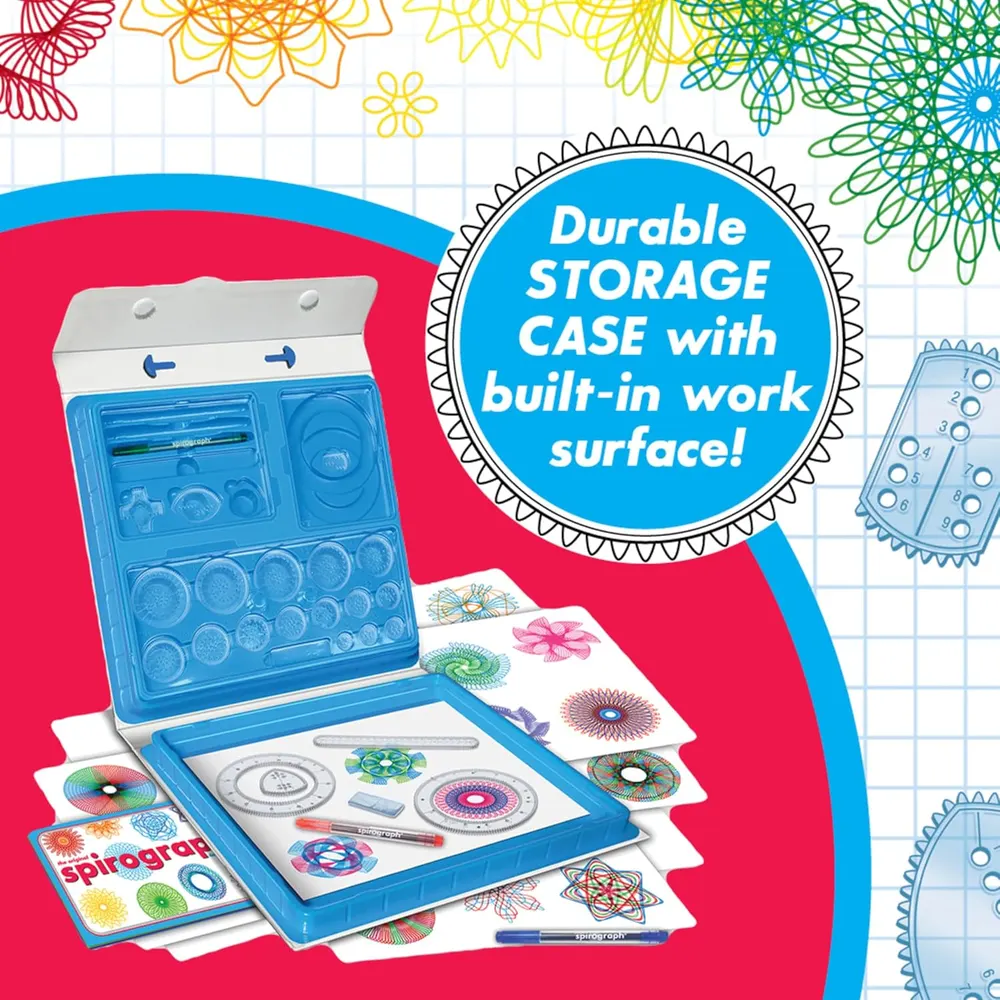
Open any classic Spirograph set and you will find the same cast: rings with teeth inside and out, wheels with teeth around the edge and a scatter of numbered holes, a straight rack, and a small lump of putty. Nothing in the box is powered, and nothing needs to be. The teeth do all the work.
Take the 96-tooth inside of a ring and a 40-tooth wheel. Both numbers divide by 8. After the wheel has gone round the ring five times, every tooth is back where it started, and the pen with it. Along the way it has drawn 96 divided by 8, which is 12, points. Swap in the 45-tooth wheel, which shares only a factor of 3 with the ring, and you will be pushing for fifteen laps to finish a 32-point design.
That is the whole secret, and it is why Spirograph is filed under both art and mathematics. Children find the rule by drawing; the formal names, hypotrochoid for inside the ring and epitrochoid for outside, can wait.
Run a wheel around the outside of a ring and the loops flip outward into petals. Run it along the straight rack and the pattern stretches into a border. Super Spirograph goes further with Spiro-Tracks that snap into outlines of your own. And if loose wheels sound like too much to manage, Cyclex locks the wheel inside the tool and advances it for you.
Design guide 01 · updated October 2026
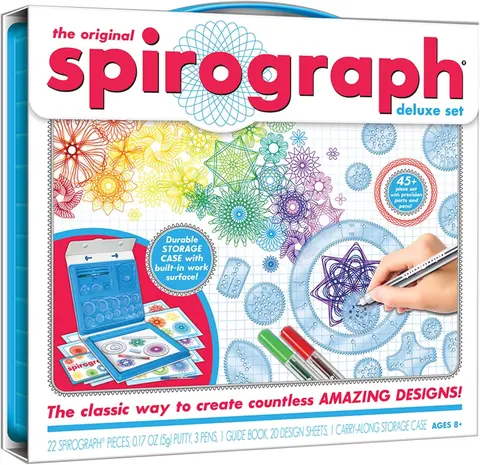
19 wheels, 2 rings and a rack in a carry case with its own drawing surface.
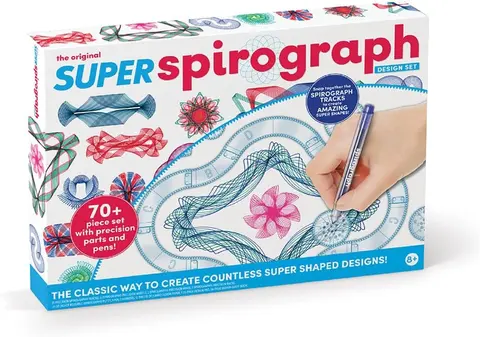
Twice the gears plus snap-together Spiro-Tracks for shapes no ring can make.
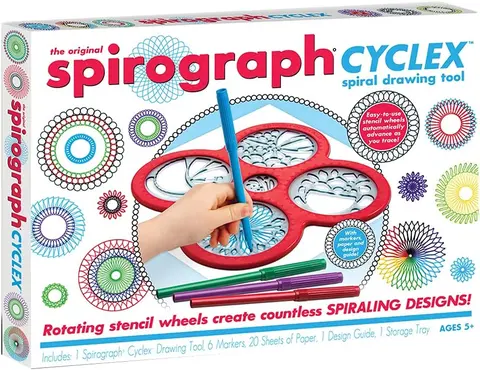
A rotating stencil wheel that advances itself after every trace.